
QP – Quench Polish
WHEN SURFACE FINISH MATTERS
TS Tech Nickel’s SBN+QP process combines the benefits of salt bath nitriding with a polished finishing process for a more even compound layer and surface.
Colors
Finishes
Corrosion Resistance
Compound Layer Depth
The Process
WHAT IS QP?
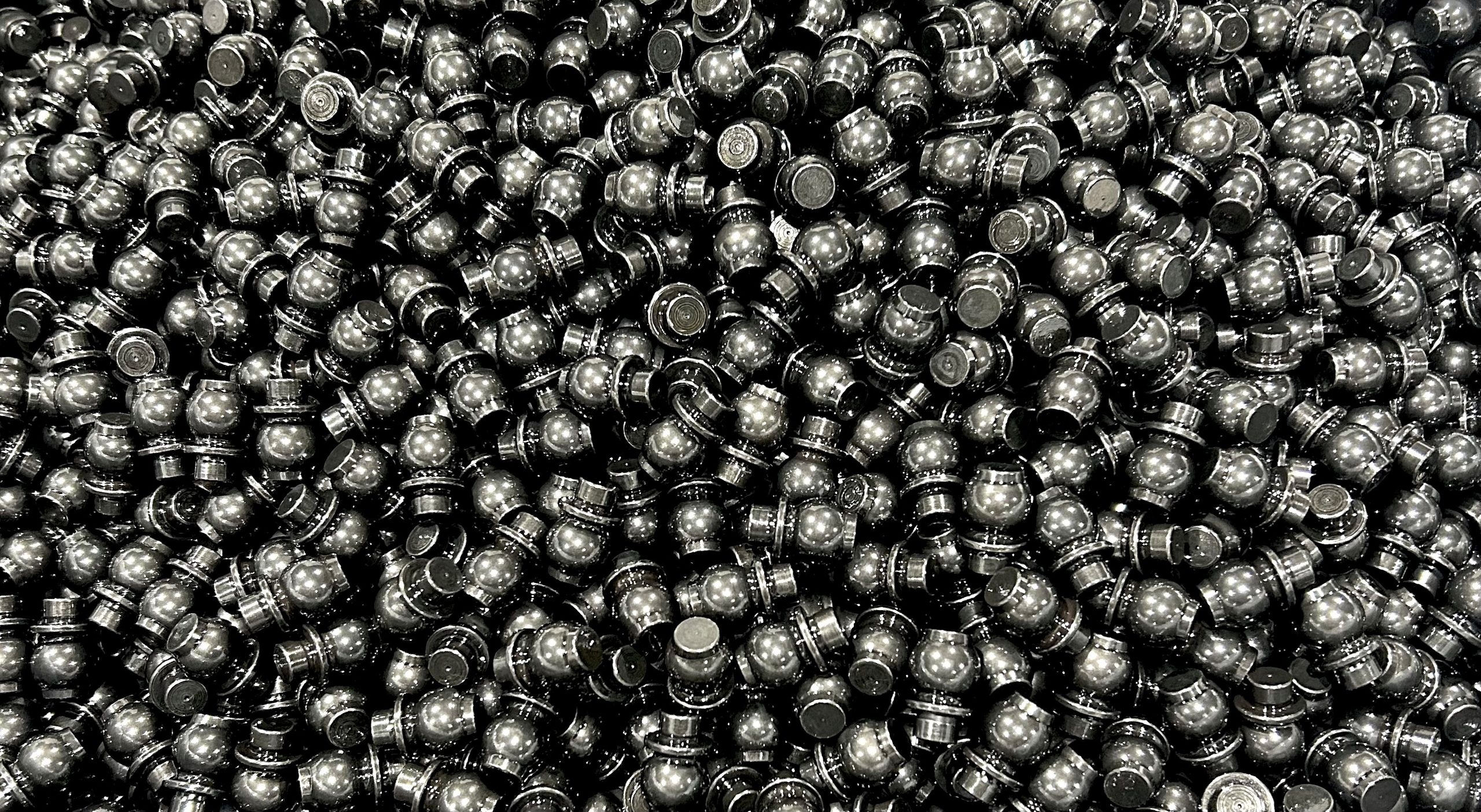
All the benefits of salt bath nitriding plus a polished finish to remove the slight roughness of the compound layer as deposited.
With the “QP” process, parts are first treated with the salt bath nitriding process, which deposits an “eggshell” or compound layer. This layer provides the high surface hardness and other benefits of the SBN process; however, the finish is similar to what you would see with a flat paint—not rough but also not quite smooth. While the SBN process creates a more even compound layer than other processes such as gas nitride, it is still not microscopically smooth. Adding a polishing step, whether it’s a vibratory polish with ceramic media or shot blasting with glass beads, alters the surface to more of a smoother look and feel. Combined with a finishing oil, it can produce a smooth, black finish.
Salt Bath Nitriding has many aliases. Here is a sample listing:
- Black Nitriding
- Melonite®
- SURSULF®
- Arcor®
- Tenifer®
- Tufftride®
- Nu-Tride®
Materials Treated
What Can We Treat
These material types are compatible with this process.
- Low Carbon Steel
- Alloy Steel
- Stainless Steel
- Tool Steel
- Cast Iron
- Ductile Iron
- Powdered Sintered Steels
- Hardened Steel
- Inconel
- Nitriding Grade Steel
- 3D Printed Steel
Why Choose QP
Advantages & Benefits
INCREASED HARDNESS
Raises surface hardness to 55 HRC+.
Corrosion Protection
Salt spray resistance to 100 hours+.
MINIMAL DISTORTION
Low temperature process means low distortion potential.
ABRASION RESISTANCE
Withstands wear, friction, or surface erosion.
IMPROVED FATIGUE STRENGTH
Increases what a material can withstand under repeated or cyclic loading.
LOW COEFFICIENT OF FRICTION
Compound layer reduces frictional wear.
INCREASED LUBRICITY
Especially with application of finishing oil.
STABLE
No peeling or flaking like with other blackening finishes.
Technical Data
Specifications
All of TS Tech Nickel’s Salt Bath Nitriding processes conform to the stringent aerospace standard AMS2753. Key characteristics are listed.
Compound Layer Thickness
Up to 30 microns.
Surface Hardness
Carbon/alloy steels: 55+ HRC – Stainless Steels: ~70 HRC.
Process Temp
950F – 1075F
Colors
Black, Grey
Tank Capacities
30″ W x 30″ L x 48″ H. Contact us about larger parts.
Compliance
Process: AMS2753
Pyrometry: AMS2750
Growth
Generally 50% of compound layer thickness.
Applications
Common Applications

Firearm Components
For a deep black finish that won’t peel, crack or flake.

Automotive Parts
A variety of applications for frictional wear resistance and corrosion resistance.
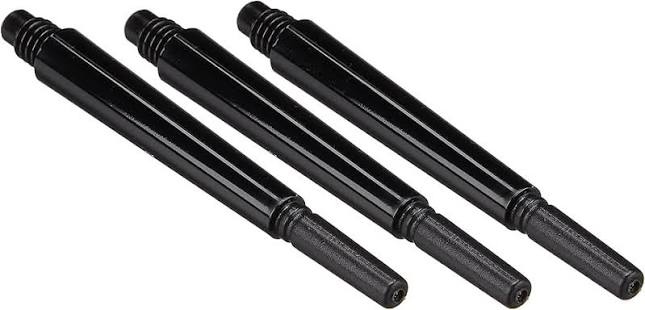
Gears & Shafts
Added surface hardness and corrosion resistance.

Hydraulic Cylinders
Smooth, hardened finish to replace traditional chrome plating.

Bushing Pins
Increased lubricity and corrosion resistance.

Defense & Aerospace
Among the most demanding applications, AMS2753 was specifically written for the process.
FAQs
Frequently Asked
Questions
You’ve got questions? We’ve got answers.
QP is an acronym for Quench, Polish. It is a finishing designation specific to TS Tech Nickel’s salt bath nitriding (SBN) process where the parts will be “quenched” in an oxidizing salt to add an oxide layer on top of the compound layer, and then polished by mechanical means, either with vibratory polishing equipment or various types of bead blasting (glass, steel shot, or aluminum oxide).
The SBN process alone will leave a texture on the surface of the parts not unlike that of an eggshell. There is a small amount of roughness imparted due to the nature of the compound layer that generally matches the surface roughness of the part itself. It can also be compared to the general roughness of flat paint. Some parts require a smooth finish, and mechanically polishing them after SBN will leave a smooth, shiny surface on the parts. When combined with a finishing/protective oil afterwards, it will produce a lighter black finish. Be sure to check out our interactive finish tool to see what finishes that TS Tech Nickel can produce for your parts.
Yes! This is accomplished with a mechanical blasting step prior to doing the salt bath nitriding process. TS Tech Nickel offers options such as glass bead, steel shot, and aluminum oxide media blasting to produce a textured finish on parts that will remain after SBN treatment. QP (or Quench, Polish) is then applied to the parts to remove the flat paint feel of the process and leave a smooth, textured finish. Combined with a finishing/protective oil as a last step will produce a lighter black finish. Check out our interactive finish tool to get an idea of the different finishes that TS Tech Nickel can put on your parts.
TS Tech Nickel recommends that you use SAE’s Aerospace Material Specification 2753 for the salt bath nitriding process as a standalone note on your part print. For the QP process specifically, use a note directly after AMS2753 specifying a polish step to achieve a smooth finish. It is also helpful to know if you require a particular color, such as the light black, as this will indicate that you’d like the finishing/protective oil to be applied or not. Without the finishing oil, the parts will have a shiny grey color after QP. For more assistance specifying your desired outcome, we encourage you to try our interactive finishing tool to see an example of results, depending on the finishing options you specify. Or you can contact us and we’re happy to help you decide which finish is best for your application.
All nitriding processes, including salt bath nitriding, are intended to be a finish process,s and therefore you should see little to no dimensional change with the process. While the process is technically a form of heat treatment, the processing temperatures are typically between 950-1075°F, which for all forms of steel is below the critical temperature where crystal structures start to change and reform (known as the austenite phase). Staying below the austenite phase means that the shape of the parts will not be affected as the steel has not started to plasticize, as with heat treatments requiring hotter temperatures such as neutral hardening or carburizing.
Having said that, the compound layer that builds into and on the surface of the parts can cause a minimal amount of growth. Typically, the compound layer will be somewhere between 10-20 microns of depth, and a general rule of thumb is that half of that depth will be above the original surface, so you can expect somewhere between 5-10 microns of growth on all surfaces. Very fine thread pitches can sometimes become brittle, but for the vast majority of applications, this is not a problem. If you are concerned about brittle thread pitches, you can mask threaded holes using the corresponding bolt, but a high-temperature anti-seize compound (rated to 1200°F minimum) must be applied to the threads prior to salt bath nitriding, or removal becomes difficult to impossible.